Urgent Flower Orders: Brief, Substitutions and Delivery
By BotMarketing.pro published updated
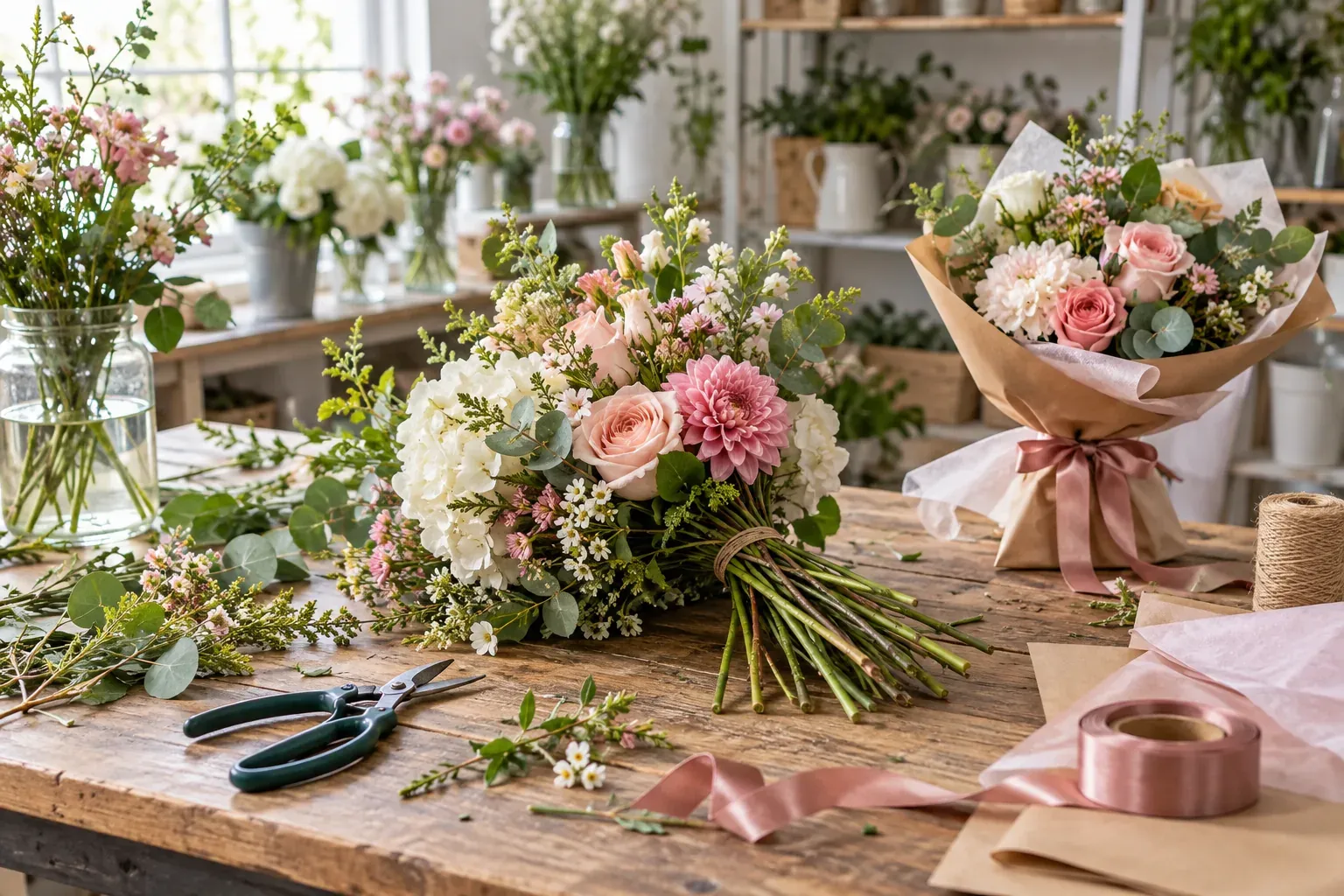
A customer asks for a bouquet “like this photo, delivered today.” Before accepting, a florist needs to know which flowers matter, where the gift is going and whether anyone can receive it. A reference image cannot establish today's stock or a delivery slot. This guide follows one urgent enquiry through a short brief, a substitution decision and a checked handover, then shows what to keep for a future occasion.
Check the brief against today's flowers and delivery capacity
Separate a ready-made bouquet from a florist-choice arrangement and a request for specific stems. Show a current photo of the actual ready-made bouquet. For a new arrangement, ask whether the priority is a particular flower, colour palette, shape or size. An older portfolio photo demonstrates your style; it does not confirm that you can reproduce its contents today.
Send one compact request for the details you need to check feasibility:
Please send:
1. The delivery date and latest acceptable arrival time, or your preferred collection time.
2. The full address, including unit, business or venue name and access instructions.
3. Your budget, specifying whether it includes delivery and any applicable charges.
4. Essential flowers, colours and anything to avoid; attach a reference if useful.
5. Your contact and the recipient's name and phone number. Is this a surprise, and may we contact the recipient beforehand?
6. The exact card message and signature.
For an overseas sender, make the recipient's local time explicit. “Before 5 pm” is a deadline, while “between 4 and 5 pm” is a delivery window; confirm which one matters. Check stems, preparation time and the actual route before offering either. A workplace may stop accepting deliveries before closing time, and a venue may require reception to take the flowers.
| What you find | What to offer | What needs agreement | When to confirm |
|---|---|---|---|
| A suitable bouquet is ready | A photo of that bouquet and the complete price | The card, address, receiving contact and delivery window | Once bouquet availability and delivery are checked |
| The requested stems need replacing | A specific alternative composition, palette and price | The changes and a latest reply time | After approval; recheck availability if the reply is late |
| The requested deadline is unavailable | A checked later window, collection or another ready bouquet | Whether that alternative still serves the customer's purpose | After the customer accepts the revised plan |
BotMarketing's catalogue can show the options, while the order and its comment can keep the enquiry together. The Mini App checkout comment allows up to 1,000 characters, so record a short brief and clarify the rest in conversation. This workflow does not assume a dedicated form that requires every address, deadline and substitution field. Stock on a product listing does not check individual stems or reserve a delivery route.
Agree on a substitution before making it
Distinguish florist choice from an essential flower
“Your choice of pink and white seasonal flowers” gives you a different brief from “the recipient specifically wants peonies.” Establish what you may change: stems, palette, approximate size, wrapping and excluded flowers. A customer who allows a flexible composition still needs to understand its price and delivery terms.
For a real example of that distinction, Interflora describes seasonal florist selection and its own substitution standards. Those standards belong to that service. Explain your own proposal rather than assuming every florist follows the same policy, and do not promise an identical silhouette when changing the flowers.
Give the customer a specific alternative and a decision time
In this fictional example, a sender requests pink and white peonies for 12 November, delivered between 4 and 5 pm in the recipient's local time. The needed peonies are unavailable today, but roses and lisianthus are available. The following prices and times illustrate a message; they are not service rates or a universal same-day cutoff.
The peonies requested for today are unavailable. We can use pink and white roses and lisianthus instead, keeping the agreed bouquet size; the flowers will have a different shape. Bouquet $65 + delivery $12 = $77 total, including all applicable charges in this example. To deliver on 12 November between 4 and 5 pm in your recipient's local time, we need your approval by 1:30 pm in that same time zone. Please reply “I approve roses and lisianthus, total $77” if this works. We will then confirm the order and payment arrangements. For a later reply, we will need to check the flowers and delivery window again.
Only offer the size and composition you can actually make. Silence is not approval for a change outside the agreed brief. At the stated reply time, tell the customer that the earlier window is no longer confirmed and offer alternatives you have checked. If money has already been taken, agree separately on how to handle the order and payment.
In BotMarketing, keep the agreed result in the order's staff note and the conversation. Staff can send an order message through the connected bot when the customer has an available Telegram contact. Sending does not establish that the customer read or approved it. “Waiting for substitution approval” is a working note in this example, not a dedicated custom order status supplied by the system.
Check who can receive the bouquet
A surprise delivery still needs an agreed way to resolve access problems. Ask whether the driver may call the recipient, or whether the sender or another named contact will help. Do not invent a recipient number to complete the brief. Leaving flowers outside or with someone else needs a previously agreed plan.
Delivery services publish their own rules for these situations. Teleflora's order information distinguishes delivery timing, restricted locations and an absent recipient. Use that as a prompt to check your own arrangements; its cutoffs and procedures are not promises you can make for your route.
- Bouquet: approved flowers and wrapping; a finished photo if promised; explicit agreement for any required substitution.
- Timing: date, destination time zone and agreed arrival window; enough time for making, packing and travel.
- Location: full address, unit or business name, access hours and the person authorised to receive the gift.
- Contacts: who approves changes, who receives the delivery and whom the driver may call.
- Card: exact approved wording and signature, with names checked rather than guessed.
- Payment: the complete price and payment state checked against your agreed dispatch terms.
- Failed handover: the agreed contact and fallback; if none is available, the driver contacts the florist for a decision.
“With the driver” does not mean “received.” Report completion from the actual handover information. If the sender changes the address after dispatch, check the new route, charge and timing before accepting the change, and make sure the driver receives it. Updating a note alone will not update someone already on the road.
A shop with several people handling the same order also needs clear responsibility between shifts. That is covered in centralising flower shop orders and staff handovers. This article focuses on confirming and completing one urgent enquiry.
Keep useful preferences for the next occasion
After delivery, ask the purchaser what they would like you to remember: acceptable colours, excluded flowers and their preferred contact method. Offer an occasion reminder only if they want one. The recipient of a gift is a different person from the purchaser; delivery details do not make the recipient a marketing subscriber.
Your bouquet has been delivered. Would you like us to contact you ahead of another occasion? Let us know the date and how much notice you prefer. We can keep your pink and white preference and flower exclusions, then confirm the next composition, budget, address and delivery afresh. If you do not want a reminder, we will not contact you again for this purpose.
Keep agreed preferences in the completed order's note so you can consult them when the purchaser returns. For a single promised reminder, create a task in your working calendar and check permission before sending it. BotMarketing does not extract an arbitrary occasion date from an order comment or automatically create an annual reminder from it. Bot messages also need an available customer chat and current permission to contact that purchaser.
A repeat order starts with fresh stock, price and delivery checks, even when the customer wants something similar. A seasonal campaign with one common date and a limited order capacity is a separate workflow; see planning seasonal gift orders.